At What Point Does a Pattern Stop Being a Coincidence?
The latest O-7 promotion slates produced six women out of one hundred nominations.

The latest Space Force O-7 promotion slate submitted to Congress included seven officers for appointment to brigadier general.
All seven were men.
Before going further, I want to congratulate these Guardians. Nobody reaches O-7 by accident. These officers have spent decades serving their country and leading others, and their accomplishments deserve recognition.
My concern is not with the individuals selected. In many ways, I am sorry that their achievement has been pulled into the gravitational pull of a broader political debate. The issue is not whether these officers earned promotion.
The question is whether the process producing these outcomes can withstand scrutiny and maintain the trust of the force it serves.
According to the 2025 Air & Space Forces Almanac, women made up 14% of Space Force O-6s as of Sept. 30, 2024. That does not mean 14% of this specific O-7 list should have been women. Not every colonel is eligible for promotion in a given year, and with a list as small as seven names, a result of zero women could be due to small numbers.
The concern is not the Space Force list by itself. The concern is what happens when that list is viewed alongside the most recent O-7 promotion slates from the Air Force, Army, Navy, and Marine Corps.
Viewed separately, each list may be explainable. Viewed together, a broader pattern emerges.
Across the most recent O-7 promotion slates from the five military services, 100 officers were advanced toward flag and general officer rank.
Only six were women.
Air Force: 33 names, 4 women
Army: 29 names, 2 women
Navy: 22 names, 0 women
Marine Corps: 9 names, 0 women
Space Force: 7 names, 0 women
That amounts to 6 women out of 100 officers, or 6.0%.
Statistically, a single promotion board can produce outcomes that differ substantially from the demographics of the broader force. The concern is not any individual board. The concern is that multiple boards across multiple services are producing similar outcomes at the same time. Patterns that may be unremarkable in isolation become more significant when they repeat across organizations.
According to the Department of Defense Personnel, Workforce Reports & Publications data, women held approximately 11.5% of O-7 positions across the U.S. military as of September 2024. The relevant promotion pools for each board are smaller and not publicly available, making direct comparisons difficult. Nevertheless, the most recent O-7 nomination slates produced a level of female representation substantially below the percentage of women currently serving at the O-7 level, raising questions that warrant additional transparency.
The Air Force’s recent promotion slate demonstrates that female representation at O-7 is possible. Four of the Air Force’s 33 brigadier general selectees were women, representing nearly 12% of the list.
That makes the outcomes in the Navy, Marine Corps, and Space Force worthy of closer examination. The issue is not that women cannot be promoted to O-7. The issue is why some services continue to produce promotion lists with little or no female representation while others do not.
Women comprise roughly 18% of the active-duty force. Promotion pools are smaller and more specialized than the overall force, and promotion outcomes should not be expected to mirror force demographics exactly.
The purpose of this analysis is not to claim discrimination from promotion outcomes alone, but to examine patterns that may warrant additional scrutiny and transparency.
However, the gap between overall representation and recent O-7 outcomes raises legitimate questions about the promotion pipeline, retention, and advancement to the military’s most senior leadership ranks.
Those questions become even harder to ignore when viewed alongside reporting that Defense Secretary Pete Hegseth removed two women and two Black men from a previously developed Army brigadier general promotion slate before it was finalized. Subsequent reporting has raised similar questions regarding Navy flag officer promotion decisions. Standing alone, any one of these events might be explainable. Viewed together, they reinforce the need for greater transparency into how senior leader promotion decisions are being made. In the absence of transparency, confidence in the process becomes harder to maintain.

To be clear, this is not an argument for quotas. It is not an argument that anyone should be promoted because of their sex. It is a question of transparency.
Transparency is not a threat to meritocracy. It is what allows the force to trust that meritocracy is working.
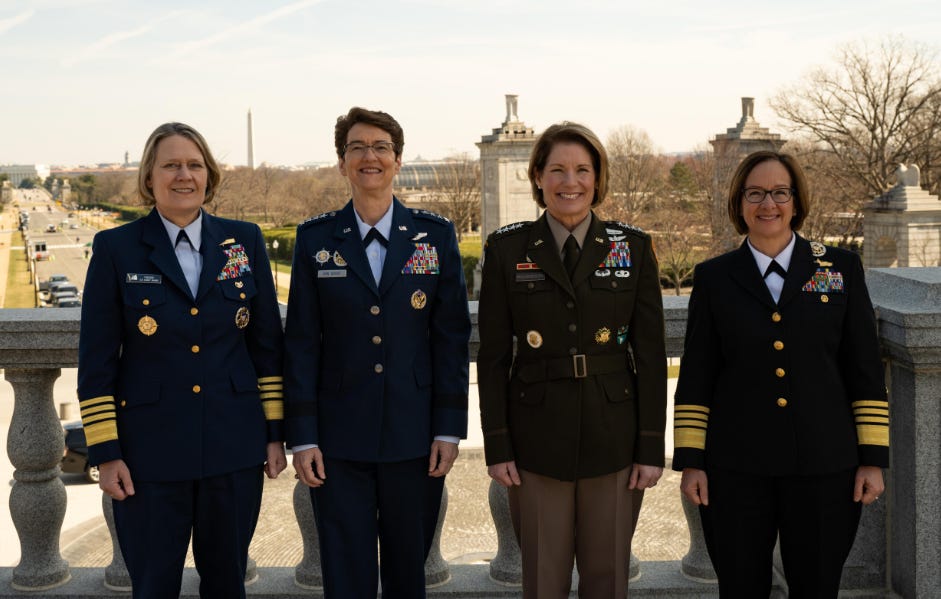
The military has spent decades recruiting, training, educating, and developing talented women leaders. Women command squadrons, ships, battalions, wings, and installations. They fly combat aircraft, command warships, lead cyber operations, and serve in virtually every military occupational specialty.
Yet when promotion slates continue to emerge with little or no female representation, service members are left asking a reasonable question:
Where are they?
The answer matters because promotion lists do more than determine who wears stars. They send signals.
Every major, lieutenant colonel, commander, and colonel is watching. Every young woman deciding whether to remain in uniform is watching.
When women repeatedly see promotion outcomes that appear to exclude them from the highest levels of leadership, the message received may not be the message intended. The perception becomes that advancement is possible—but only up to a point.
That perception affects retention.
And retention affects readiness.
A military that struggles to retain talent today will have fewer qualified leaders to promote tomorrow.
Secretary Hegseth has argued that unity, not diversity, is our strength. If unity is truly the goal, then every service member should have confidence that qualified leaders are evaluated fairly and that promotion decisions can withstand public scrutiny.
Because real unity is not built through slogans. It is built through trust and that improves retention.
Retention strengthens readiness.
And trust requires transparency.
Maybe there is a perfectly reasonable explanation for these outcomes.
If so, leadership should explain it.
Editor’s Note: The promotion lists referenced below were announced on different dates and represent the most recently available O-7 promotion slates for each military service, not a single synchronized promotion cycle.
For general and flag officers, promotion to O-7 is not complete the moment a list is announced. Officers are selected through the military promotion process, then nominated by the President and sent to the Senate for confirmation. Once confirmed, they are appointed to the higher grade according to law and service timing.
So when I refer to officers being “advanced toward” O-7, I am referring to officers who have been publicly announced or formally nominated for appointment to brigadier general or rear admiral lower half. The legal promotion process still runs through presidential nomination and Senate confirmation.
Sources
Space Force Brigadier General Nominations (PN1027, Congress.gov)
Air Force General Officer Announcements, May 20, 2026
Army General Officer Announcements, March 27, 2026
Navy Rear Admiral (Lower Half) Announcement, June 2026
Marine Corps General Officer Announcements, December 19, 2025
I firmly believe that this corrupt regime will end eventually. (I have to for my own sanity!) The problem is, how do we get back to our standards of 2024? This clown 🤡 show has sent us back decades and it will take decades to recover from this sh*t show! I’m not sure how or when but I truly believe that justice will prevail. History will not be kind to this MAGA nightmare!
the 2nd